DISCLAIMER: This project was completed as an independent Healthcare Operations & Consulting externship. I am not affiliated with, endorsed by, or employed by the Institute of Mental Health (IMH). "CareSync" is a conceptual feature created for portfolio purposes.

IMH: CareSync

Healthcare Operations & Consulting Externship

Role

UX Strategist & Product Designer

Timeline

June – August 2026

Problem

High-risk psychiatric patients defaulting due to administrative triage bottlenecks and fragmented communication.

Solution

A 3-zone decision-support dashboard driven by strict role-based routing logic to automate critical care coordination.

1. Systemic Deconstruction & Root Cause Analysis

Instead of treating case manager burnout as an inevitable reality, I utilized rigorous analytical frameworks to isolate the exact structural failures within the clinic. Utilizing an Ishikawa (Fishbone) Diagram and the 6Ms framework, I mapped out the entire operational ecosystem.

The analysis revealed that the intersection of extreme caseloads (often 100+ patients) and the lack of scheduling authority was the primary breaking point. An AI-enhanced 5 Whys analysis further pierced through surface-level software complaints to expose the true constraints: volume-based billing models and strict medical liability frameworks that force clinics to bottleneck all urgent triage through the attending physician.
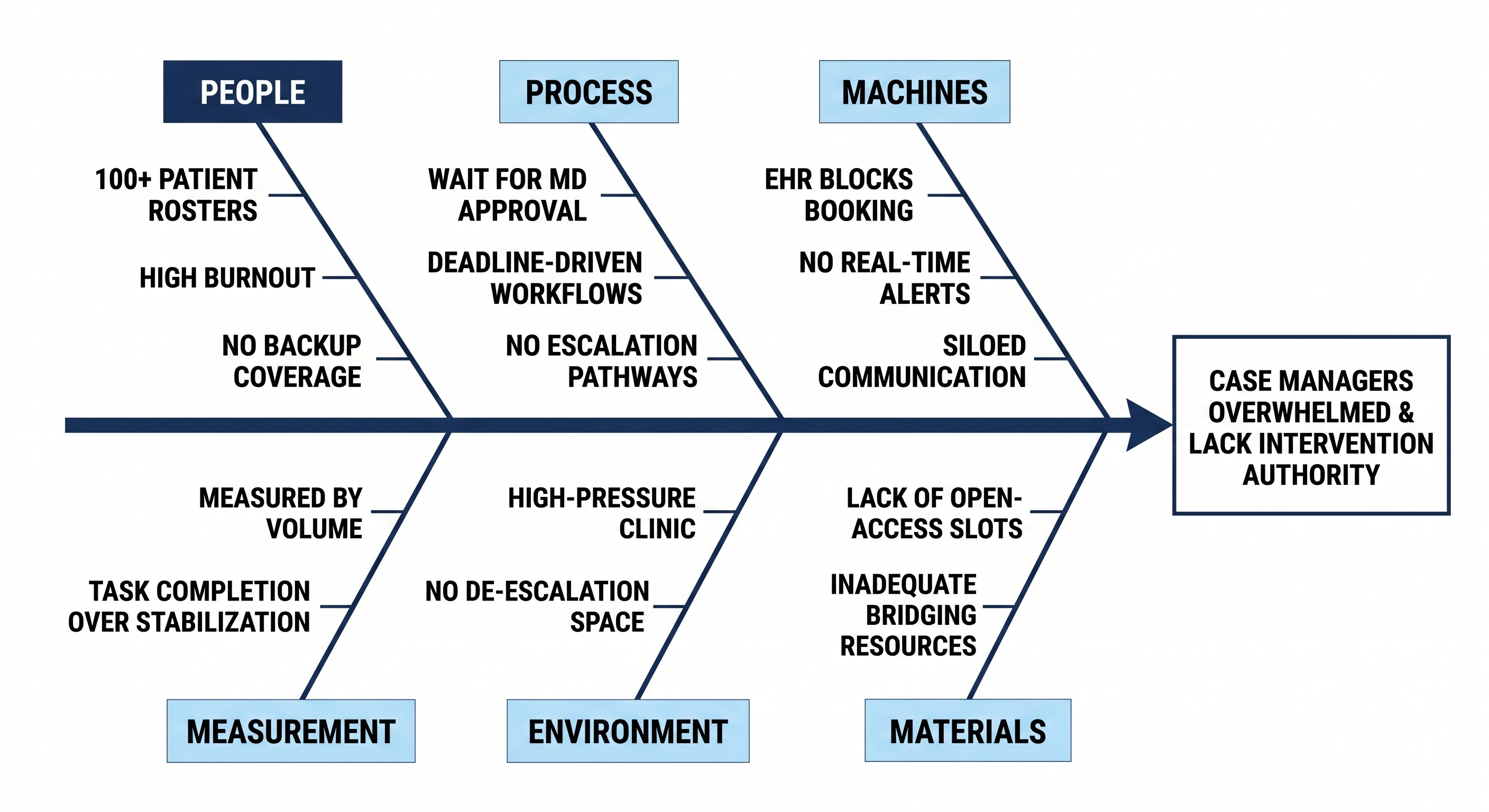
Root Cause Analysis

2. The "Invisible Labor" of Case Management

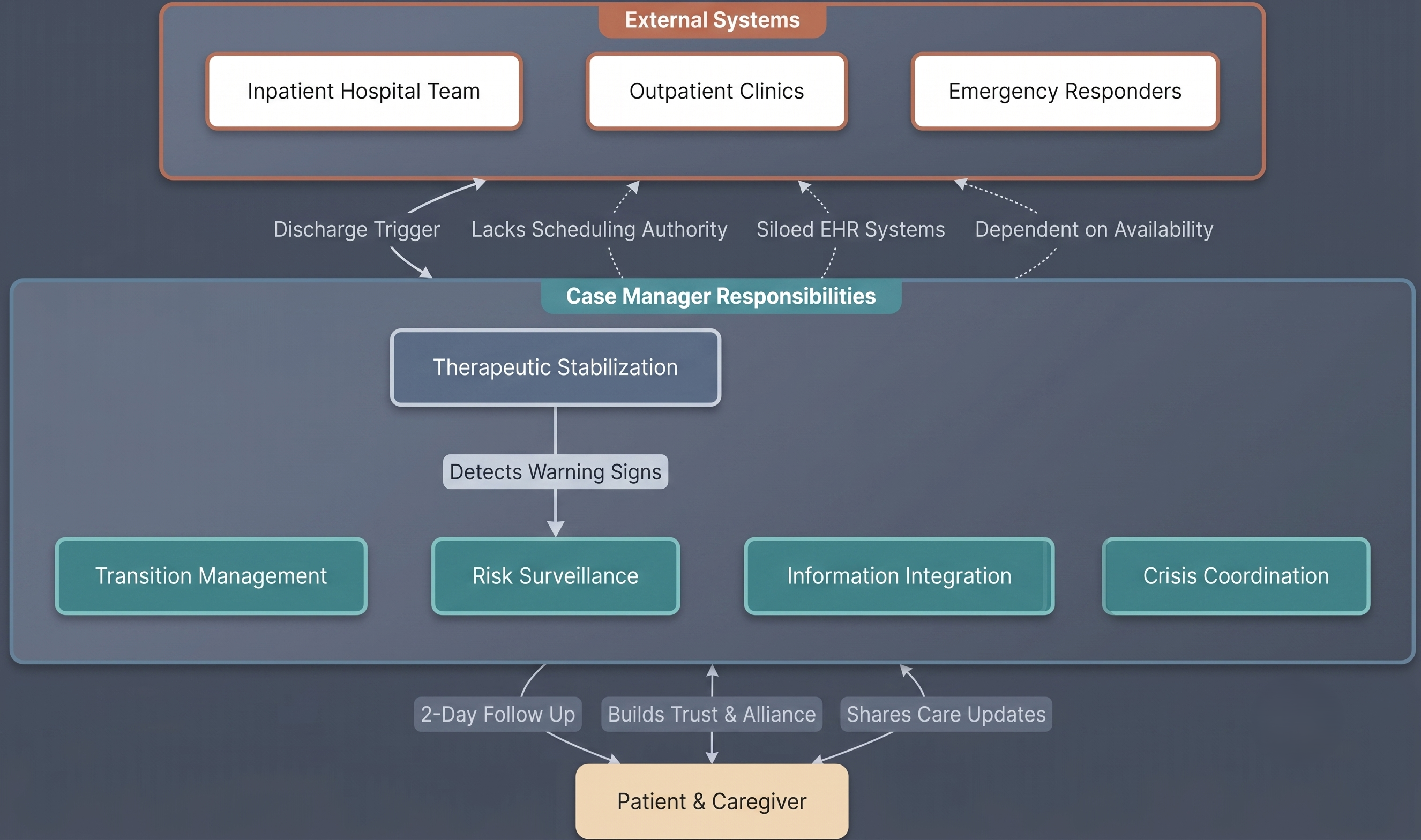
To visualize the friction, I developed a comprehensive Stakeholder Map detailing the interactions between Case Managers, patients, and external systems. This map highlighted a massive operational flaw: case managers were forced into manual, time-consuming workarounds—such as cross-checking siloed systems like EPIC and NEHR—just to verify if a patient attended a follow-up.

Because the Electronic Health Record (EHR) physically blocks non-prescribing staff from booking emergency slots, case managers were trapped in the center of a fragmented system, juggling crisis coordination without the administrative authority to execute immediate solutions.

Stakeholder Map

"The most critical breaking point wasn't clinical oversight—it was the 'invisible labor' required to bridge the gap between rigid software permissions and real-world psychiatric urgency."

3. Translating Chaos into Logic

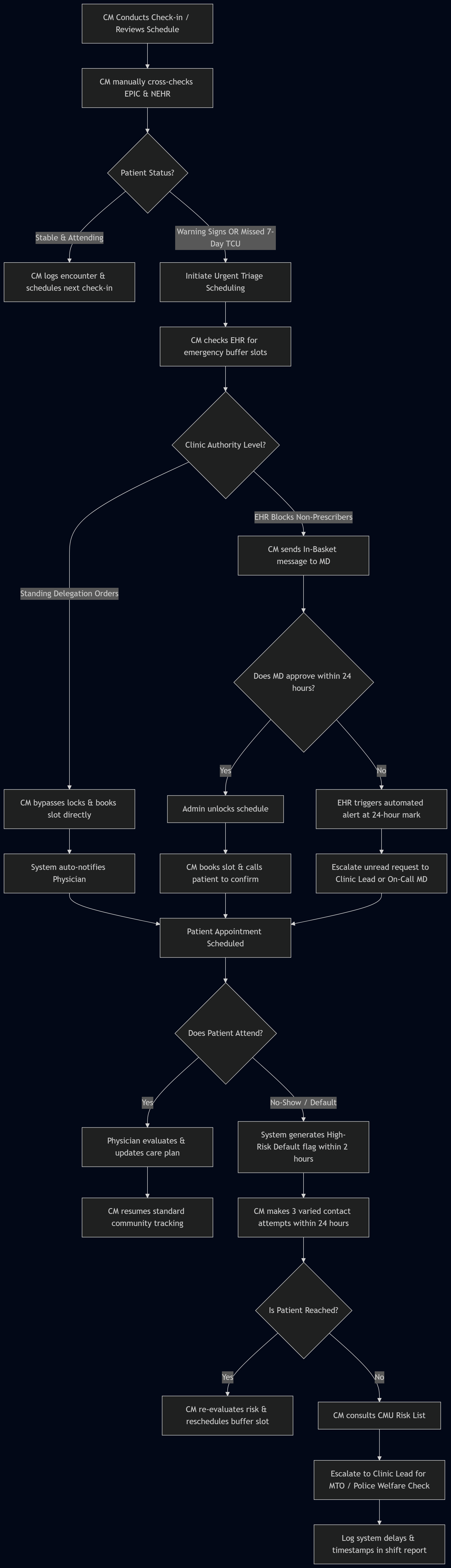
With the bottlenecks identified, I designed a strict Decision Tree for Urgent Escalation & Triage Coordination. This service blueprint deconstructs the current chaotic state and introduces strict, automated safety nets.

For example, in the current state, a case manager sends an "In-Basket" request to a physician and relies entirely on human memory to follow up. The new logic dictates: If a physician fails to approve an urgent request within 24 hours, Then the system automatically escalates the alert to a Clinic Lead or On-Call MD. This ensures no high-risk patient is left in a dangerous holding pattern.

4. CareSync Architecture & Change Management

I did not just design a dashboard; I engineered a decision-support tool driven by role-based logic. The CareSync Dashboard translates raw data into three distinct urgency zones: Zone 1 (Critical Action), Zone 2 (System Bottlenecks), and Zone 3 (Caseload Health). This ensures Case Managers only see coordination tasks, while MDs only see clinical approvals, effectively eliminating alert fatigue.

The Rollout Strategy: Knowing that enterprise software often fails due to staff resistance, I developed a Change Management plan using the People, Process, Technology (PPT) framework. To overcome the objection of "this just shows how overwhelmed we are," I reframed the dashboard as a tool that actively quantifies their invisible labor, providing hard data to advocate for safer 1:10 SAMHSA caseload limits.

Service Blueprint Logic

Process Documents & Dashboards

The final project deliverables encompassed the root cause analysis, the slide deck walkthrough, and the V2 CareSync Dashboard UI tables.